The Basics of Physics Units: Why Converting Distance, Mass, and Time Accurately is Crucial
In September 1999, NASA's Mars Climate Orbiter, a $125 million spacecraft that had travelled for nine months, arrived at Mars and was destroyed. There was no engine failure and no collision. The cause was a mix-up between English units and metric units.
Software built by one team described the thruster pushes in pound-force seconds, while the navigation software run by NASA's Jet Propulsion Laboratory expected newton-seconds. One pound-force is about 4.45 newtons, so every small correction was misread by that factor. Over months, the tiny errors added up, and the probe dipped far too deep into the Martian atmosphere.
The lesson for every student: in physics, a number without a unit is meaningless. Mastering unit translation is your first line of defence against catastrophic errors.
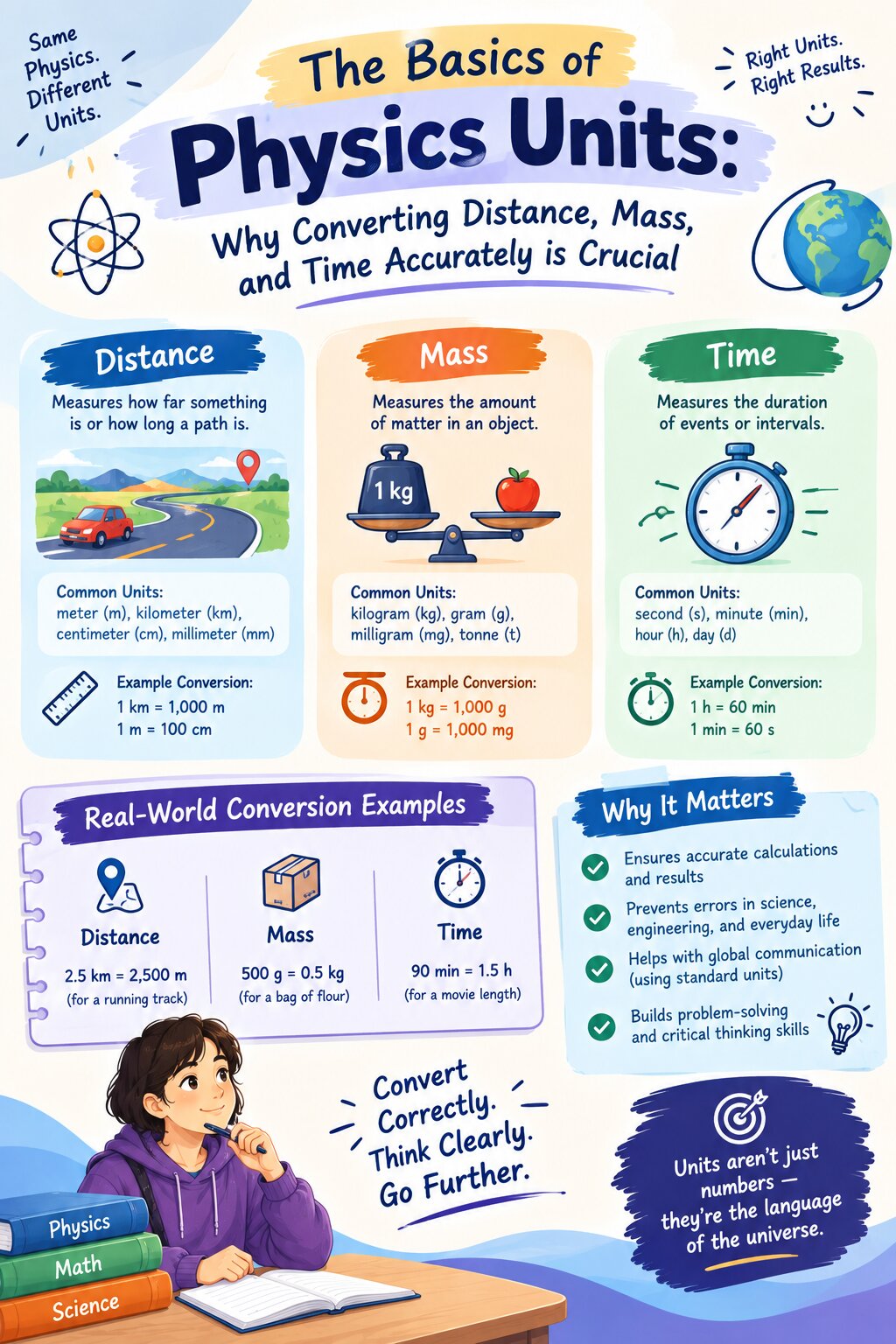
The SI System: The Universal Language of Physics
The Big Three: Meters, Kilograms, and Seconds
Scientists once measured with whatever units their country used, which made sharing results a nightmare. The solution was the International System of Units (SI), agreed internationally in 1960. It is built on base units, and for mechanics, three matter most:
| Quantity | SI base unit | Symbol |
|---|---|---|
| Length / distance | metre | m |
| Mass | kilogram | kg |
| Time | second | s |
Why these three? Almost everything in mechanics can be built from them. Speed is m/s. Acceleration is m/s². Force is the newton, defined as kg·m/s². Energy is the joule, which is kg·m²/s². Because the SI system is based on powers of ten and every scientist uses it, results can be shared, repeated and checked anywhere in the world. (SI has seven base units in total, adding the ampere, kelvin, mole and candela.)
Multi-Step Conversions: Moving from km/h to m/s
Handling Compound Units
A compound unit like km/h has two parts, and you must convert both. The trick is to treat units like algebra: write each conversion as a fraction equal to 1, and let the unwanted units cancel.
Problem: A road has a speed limit of 90 km/h. What is that in m/s?
Write the starting value with units: 90 km/h.
Convert kilometres to metres with the fraction (1,000 m ÷ 1 km). Convert hours to seconds with (1 h ÷ 3,600 s), because 1 h = 60 min × 60 s = 3,600 s.
Multiply so the old units cancel:
= (90 × 1,000) ÷ 3,600 m/s
= 90,000 ÷ 3,600 = 25 m/s
Shortcut: since 1,000 ÷ 3,600 = 1/3.6, you can divide km/h by 3.6 to get m/s, or multiply m/s by 3.6 to get km/h. Check: 25 × 3.6 = 90 ✓.
| km/h | m/s |
|---|---|
| 36 | 10 |
| 54 | 15 |
| 72 | 20 |
| 108 | 30 |
Watch out for squared units. Squaring a length also squares the conversion factor. Since 1 m = 100 cm, then 1 m² = 100 × 100 = 10,000 cm², not 100.
How Unit Mix-ups Secretly Destroy Lab Grades
You will probably never crash a spacecraft, but you can easily lose marks the same way. Most formulas in physics only work when every quantity is in SI units. The classic traps are plugging grams into a formula that needs kilograms, or centimetres where metres are required.
Right: 500 g = 0.5 kg → ½ × 0.5 × 4² = 4 J
The wrong answer is 1,000 times too large.
Right: 50 cm = 0.5 m → 2 × 9.8 × 0.5 = 9.8 J
The wrong answer is 100 times too large.
- Convert first, calculate second. Change every value to SI before substituting into a formula.
- Check the formula's unit hints. If g = 9.8 m/s², your lengths must be in metres and your times in seconds.
- Sanity-check the size. A pencil does not have 4,000 joules of energy. An absurd answer is a clue that a unit slipped.
Conclusion: Secure Your Physics Calculations
Always write the units next to every number in your scratchwork, and cancel them like algebra as you go. If the units on your final answer are wrong, the working is wrong, even when the number looks right.
Before you turn in a problem sheet, double-check your conversions with our Unit Converter, our Speed Converter, or the Energy Converter. For full worked solutions, visit Physics Homework Help.