How to Balance Chemical Equations Safely and Accurately: A Chemistry Primer
A chemical equation is not just a maths puzzle. It is a recipe for building the physical universe: it tells you which ingredients go in and what comes out. And just like in a kitchen, you can't invent ingredients out of thin air.
Nature demands absolute balance. You cannot simply mash elements together and hope the atoms sort themselves out. The good news is that balancing equations follows a reliable routine. Master the Inventory Method below and even intimidating formulas become a foolproof, step-by-step process.
The Law of Conservation of Mass: Nature's Golden Rule
Reactants vs. Products
Every equation has two sides separated by an arrow that means "yields" or "produces":
(what you start with)
(what you end up with)
The Law of Conservation of Mass, established by the chemist Antoine Lavoisier in the 1700s, says that matter is neither created nor destroyed in a chemical reaction. Atoms are only rearranged into new combinations. In plain language: what goes in must come out. If you start with 4 hydrogen atoms, you must finish with exactly 4 hydrogen atoms, only now attached to different partners.
That is the whole reason we balance equations. An unbalanced equation says atoms vanished or appeared from nowhere, and nature does not allow that.
Coefficients vs. Subscripts: The #1 Student Pitfall
The Unbreakable Rule of Molecular Identity
Subscript (small, inside)
The little number in H2O tells you how many atoms of that element are in one molecule. It defines what the substance is.
Coefficient (big, in front)
The number in 2H2O tells you how many whole molecules you have. It changes the quantity only.
2 molecules × 1 oxygen atom = 2 O atoms
✗ Never change a subscript
Changing H2O to H2O2 doesn't "add an oxygen". It creates a completely different substance, hydrogen peroxide, used as a bleach and, in high concentrations, as a rocket propellant. Water has become something else.
✓ Only change coefficients
You are free to scale how many molecules you have, because 2H2O is still just water, only more of it.
Golden rule: coefficients are your dials, subscripts are locked.
The 4-Step Inventory Method Blueprint
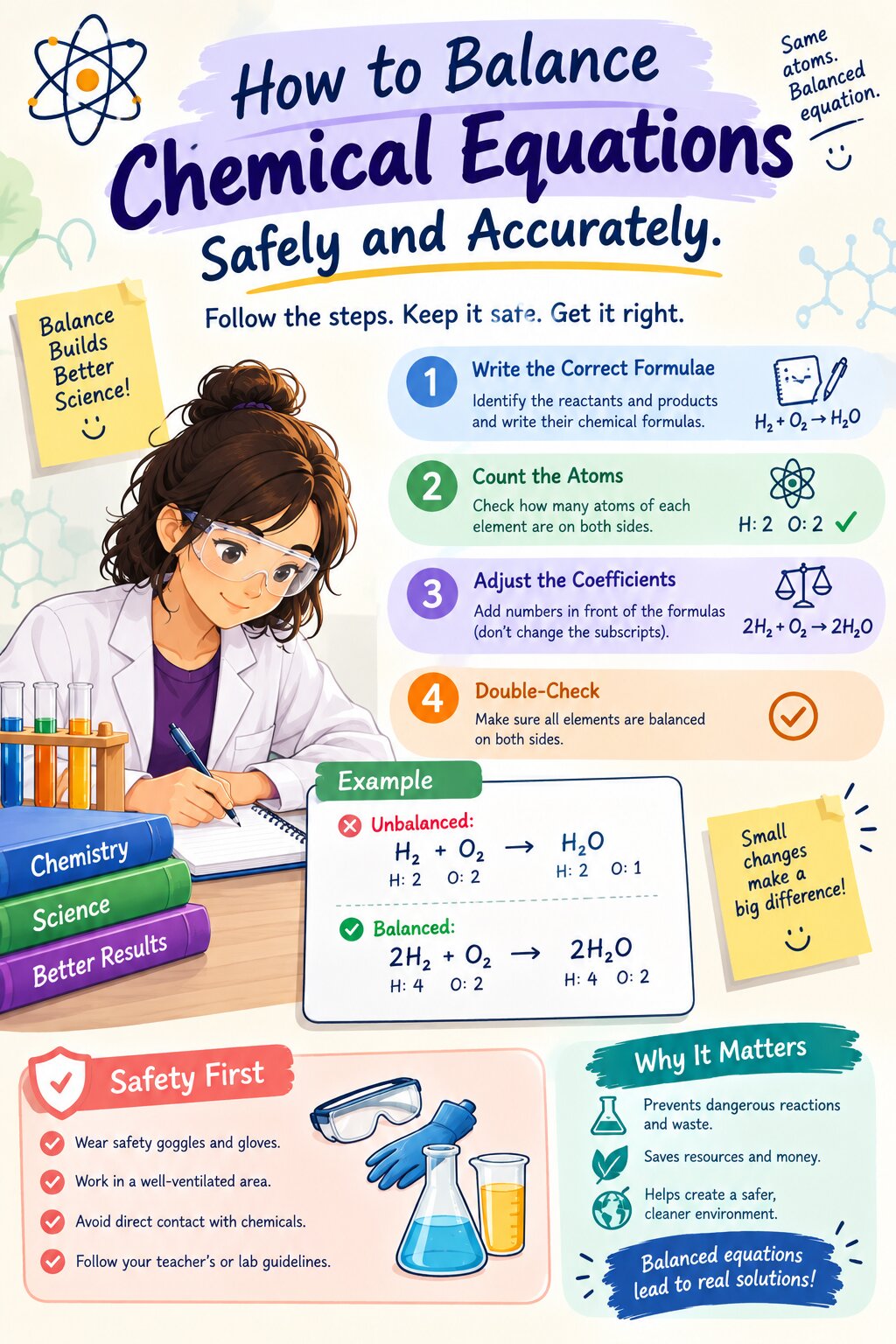
Count the atoms of every element on both sides and write an inventory.
Add a coefficient to balance one element at a time. Start with an element that appears in only one compound on each side, and leave elements that appear alone (like O2 or H2) for last.
Update your inventory after every change, because one coefficient can unbalance another element.
Check both sides one last time and confirm every element matches.
Worked Example: The Formation of Water
Step 1: Count. The left has 2 H and 2 O. The right has 2 H and only 1 O. Oxygen is out of balance.
Step 2: Fix oxygen. Put a 2 in front of H2O to get 2 oxygen atoms on the right:
Step 3: Update. Now the right side has 4 H (2 × 2) and 2 O (2 × 1), but the left has only 2 H. Hydrogen is now unbalanced, so put a 2 in front of H2:
| Element | Left side | Right side | Balanced? |
|---|---|---|---|
| Hydrogen (H) | 2 × 2 = 4 | 2 × 2 = 4 | ✓ |
| Oxygen (O) | 1 × 2 = 2 | 2 × 1 = 2 | ✓ |
Step 4: Verify. 4 H and 2 O on each side. Balanced.
Try One More: Burning Methane
- Carbon: 1 on each side, already balanced.
- Hydrogen: 4 on the left, 2 on the right, so write 2H2O (now 4 H).
- Oxygen: the right now has 2 (in CO2) + 2 (in 2H2O) = 4, so write 2O2 on the left.
Check: C = 1/1, H = 4/4, O = 4/4 ✓.
Conclusion: Become a Chemistry Expert
Track your atomic tallies by hand on paper first. Writing the inventory builds the habit of thinking in atoms, which is what examiners reward. Once you have your coefficients, cross-verify them with our Chemistry Homework Help solver to guarantee error-free problem sets.
Then take the next step with the Molarity Calculator or explore our other student calculators.