The Ultimate Guide to Understanding Fractions, Decimals, and Percentages
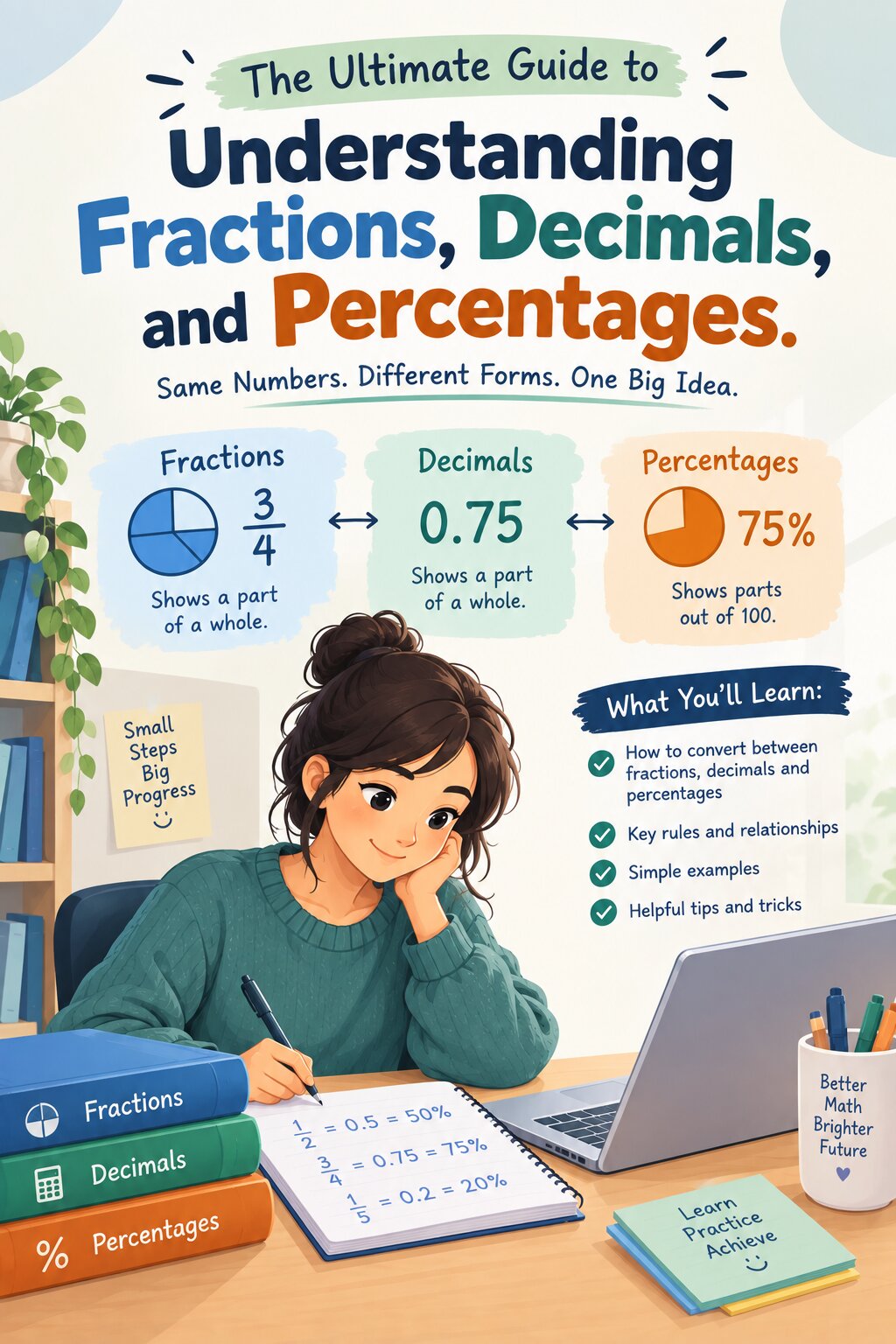
Picture a pizza cut into 4 equal slices. You eat 3. Did you eat 3/4 of the pizza, 0.75 of it, or 75% of it? All three. It is the same pizza and the same amount, just dressed in three different outfits.
That is exactly why fractions, decimals and percentages confuse so many students: they look different, so they feel like three separate topics. They are not. Learning to switch fluidly between them is the ultimate mathematical cheat code for middle and high school, and this guide shows you how, one step at a time.
1. Demystifying Fractions: Parts of a Whole
Numerators vs. Denominators (Top vs. Bottom)
A fraction describes part of a whole. It has two numbers separated by a line:
- Denominator (bottom): how many equal parts the whole is split into.
- Numerator (top): how many of those parts you are talking about.
Back to our pizza: it is cut into 4 slices (denominator = 4) and you eat 3 (numerator = 3), so you ate 3/4.
3 of 4 equal slices eaten = 3/4
The line between the numbers is not decoration. It is a division bar, and 3/4 literally means "3 divided by 4". Hold on to that idea, because it unlocks every conversion later in this guide.
Fractions can often be written more simply. 6/8 is the same as 3/4 because both numbers divide by 2. Finding the biggest shared divisor is easy with our GCF & LCM Calculator.
2. Decoding Decimals: Fractions in Disguise
Place Value Is Just a Hidden Denominator
A decimal is a fraction whose denominator is 10, 100, 1,000 and so on. The digits after the decimal point tell you which one:
- 0.7 = 7/10 (seven tenths)
- 0.75 = 75/100 (seventy-five hundredths)
- 0.125 = 125/1,000 (one hundred twenty-five thousandths)
Money makes it easy to see. One rupee is 100 paise. So 25 paise is 25/100 of a rupee, which is ₹0.25, or one quarter. Every time you count change, you are already using decimals and fractions together.
3. Percentages: Out of One Hundred
The Meaning of the '%' Symbol (Per-Cent = Per Hundred)
The word percent comes from the Latin "per centum", meaning per hundred. A percentage is simply a fraction with a permanent denominator of 100:
That fixed denominator is why percentages are so popular. It is much easier to compare 18 out of 24 and 45 out of 60 when both are converted to a score out of 100:
45/60 = 3/4 = 75%
Two different-looking marks, one identical result. You will see percentages in exam scores, discounts, interest rates and battery levels, so this skill pays off daily.
4. The Conversion Matrix: How to Switch Between Them Step-by-Step
Fraction to Decimal (The Division Method)
Remember that the fraction bar means "divided by". To change a fraction to a decimal, divide the top by the bottom. Let's use a tricky one: 1/8.
8 does not go into 1, so add a decimal point and zeros: 8 goes into 10 once (0.1), into 20 twice (0.12), into 40 five times (0.125).
Decimal to Percentage (The "Move the Dot Two Places" Trick)
To turn a decimal into a percentage, move the decimal point two places to the right (this is multiplying by 100) and add the % sign. To go back, move it two places left.
| Step | What you do | Result |
|---|---|---|
| 1 | Start with the fraction | 1/8 |
| 2 | Divide top by bottom (1 ÷ 8) | 0.125 |
| 3 | Move the dot 2 places right | 12.5 |
| 4 | Add the % sign | 12.5% |
Common Conversions to Memorize
| Fraction | Decimal | Percentage |
|---|---|---|
| 1/2 | 0.5 | 50% |
| 1/4 | 0.25 | 25% |
| 3/4 | 0.75 | 75% |
| 1/5 | 0.2 | 20% |
| 1/10 | 0.1 | 10% |
| 1/8 | 0.125 | 12.5% |
| 1/3 | 0.333… (repeating) | 33.3% |
Summary: Streamline Your Homework Prep
Fractions, decimals and percentages are one idea in three outfits. Practicing the conversions by hand, dividing top by bottom and moving the dot, builds the number sense that exams reward. Once you have done the working yourself, run the numbers through our free Percentage Calculator to check your answer instantly.
Want more practice? Visit Maths Homework Help for step-by-step solutions, or browse all our student calculators.