Newton’s Three Laws of Motion Explained with Everyday Examples
You are standing in a city bus when the driver brakes hard. Your body lurches forward, even though nobody pushed you. It feels like the bus did something to you, but the real explanation is the opposite: your body simply kept doing what it was already doing.
That small moment contains a big idea, and Isaac Newton wrote it down in the 1600s. His three laws of motion explain almost every force-and-motion problem you will meet in school physics. Here they are, in plain language, with examples from the road, the cricket ground and the kitchen.
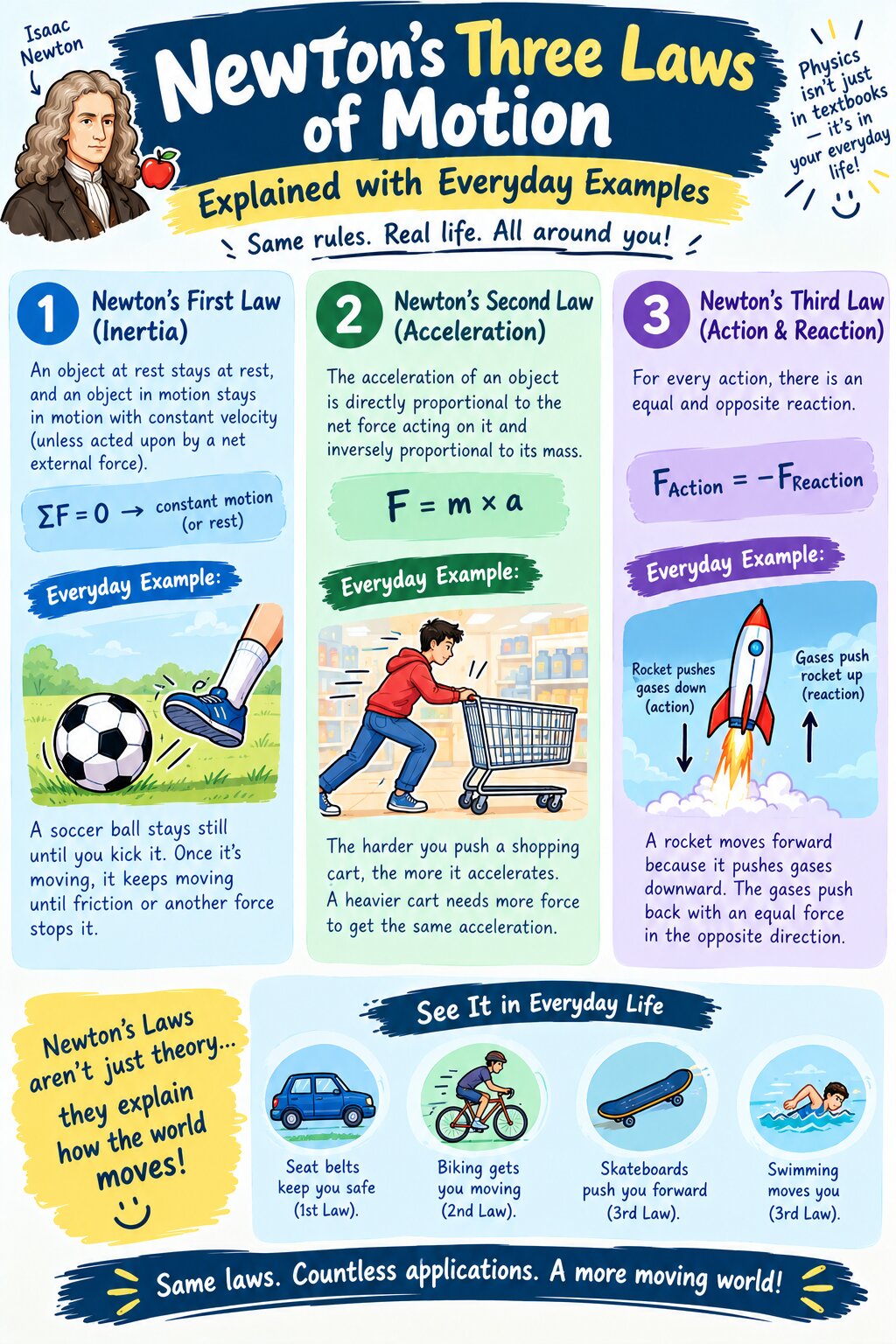
First Law: Inertia
Why Objects Resist Changes in Motion
Newton’s first law says: an object stays at rest, or keeps moving in a straight line at constant speed, unless a net force acts on it.
This resistance to change is called inertia, and mass is its measure. The more mass an object has, the harder it is to start, stop or turn.
- The bus jerk: when the bus stops, your body wants to keep moving forward at the old speed. The seat or the handrail has to supply the force that stops you.
- The tablecloth trick: yank a cloth quickly and the plates stay put, because there is not enough time for the force to change their motion.
- Seat belts: they apply the stopping force on you gently, instead of the windscreen doing it suddenly.
Second Law: F = ma
Force, Mass, and Acceleration, Step by Step
The second law tells you how much an object’s motion changes when a force acts on it:
Force (N) = mass (kg) × acceleration (m/s²)
1 newton = 1 kg·m/s²
More force means more acceleration. More mass means less acceleration for the same force. Here are two worked examples.
a = F ÷ m = 10 ÷ 2 = 5 m/s²
In real life there are usually several forces, so you use the net force, which is the combined result after adding forces that point in opposite directions.
Net force = 50 − 20 = 30 N
a = 30 ÷ 10 = 3 m/s² in the direction of your push
Always write the unit after every number. If your final unit is not m/s² for acceleration, something went wrong earlier.
Third Law: Action and Reaction
The third law says: when one object pushes on another, the second pushes back on the first with an equal force in the opposite direction. Forces always come in pairs.
- Walking: your foot pushes the ground backward, and the ground pushes you forward.
- Swimming: your hands push water backward, and the water pushes you forward.
- A rocket: it pushes hot gas downward, and the gas pushes the rocket upward.
Why Don’t Action and Reaction Cancel Out?
This is the most common confusion. The two forces in a pair act on different objects. When you push a wall, your push acts on the wall, while the wall’s push acts on you. Forces only cancel if they act on the same object.
4 Common Misconceptions
How to Draw a Free-Body Diagram
A free-body diagram is the fastest way to set up a Newton’s second law problem. Follow these three steps:
Isolate the object. Draw it as a simple box or dot, with nothing else around it.
Draw every force as an arrow acting on that object: weight pointing down, the normal force pointing up from the surface, friction, and any push or pull. Label each one.
Add up the forces along each direction to get the net force, then apply F = ma.
Conclusion: See the Laws Everywhere
Once you know the three laws, the world starts to look different: the jolt in a bus, the kick of a football, the push of a swimmer off the wall. Inertia explains why things keep moving, F = ma explains how much they change, and action and reaction explains why forces come in pairs.
Write the unit in every step of your numericals, then check your answers with Physics Homework Help or the StudyHelpAI homework solver. You can also convert units quickly with the Unit Converter.