Step-by-Step Guide: How to Properly Proofread and Fact-Check Your Academic Work
You spent three evenings on that essay. The argument is sharp, the research is solid, and the structure flows. Then it comes back with a lower grade than you expected, and the margins are full of red ink: a missing apostrophe, "there" instead of "their", a date that is off by ten years.
That is the tragedy of the preventable slip. Writing the rough draft is only about 70% of the job. The final 30% belongs to rigorous editing, and most students skip it or do it badly.
Here is the key idea: proofreading is a different skill from writing. To catch errors in your own work, you have to trick your brain into reading it with completely fresh eyes. This guide gives you three techniques that do exactly that.
Both halves decide your grade
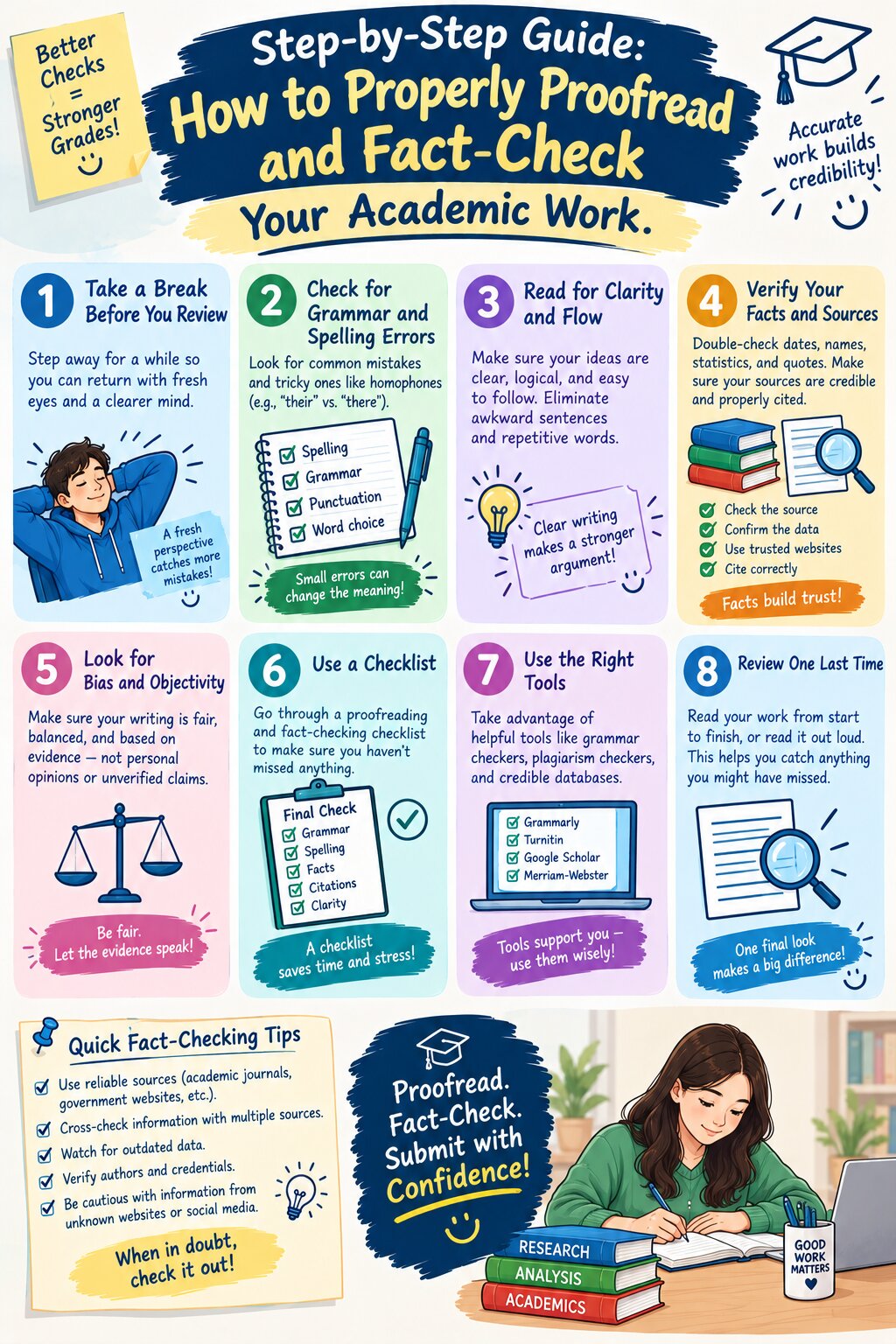
The "Backward Reading" Trick for Spotting Hidden Typos
Breaking the Brain's Auto-Correct Reflex
Why can you read your own essay five times and still miss "teh" or a doubled "the the"? Because you wrote it. Your brain already knows what the sentence is supposed to say, so while reading it predicts the next word and quietly fills in or skips errors. Your eyes see the mistake. Your brain corrects it before you notice.
The fix is to break the prediction loop by removing the meaning that your brain relies on:
Start at the very last sentence of your essay.
Read only that sentence, slowly, pointing at each word with your pen or finger.
Move to the second-to-last sentence, and keep working backward to the first.
For spelling-heavy sections (names, technical terms), read word by word, right to left.
Because the sentences are now out of order, your brain can't predict what comes next and has to read what is actually on the page:
Bonus tip: Leave your work alone for a few hours, or overnight, before proofreading. Distance makes your brain less certain of what it "knows" the text says.
The Sound Test: Reading Out Loud to Catch Awkward Sentences
Reading silently is fast, and fast reading skips problems. Reading out loud forces you to process every word at speaking speed, and your ears catch what your eyes miss. Read your essay aloud in a quiet room, or whisper it, and listen for these warning signs:
- You run out of breath. The sentence is probably a run-on and needs splitting.
- You stumble. The phrasing is clumsy or a word is missing.
- You pause where there is no punctuation. A comma or full stop is probably needed.
- You repeat the same word three times in one paragraph.
Mark every spot where you stumbled with a pencil, then fix them all after you finish reading. Don't edit mid-sentence, or you'll lose your flow.
Fact-Checking Data, Units, and Mathematical Outputs
Eliminating Factual Slips
A beautifully written essay with a wrong date or a miscalculated figure loses credibility fast. Fact-checking is a separate pass from proofreading, so do it on its own. Highlight every claim that could be wrong and verify it:
| What to check | How to verify |
|---|---|
| Dates and historical names | Confirm spelling and year in your textbook and one other reliable source. |
| Scientific figures | Check the value and its unit against your syllabus notes. Is it per second or per hour? |
| Quotations | Compare word for word with the original, and name the right person. |
| Maths and statistics | Redo each calculation from scratch without looking at your first answer. |
For maths and unit conversions, audit every line, because one slip can corrupt everything after it:
The unit is wrong: 75 is in km/h. Convert: 75 ÷ 3.6 = 20.8 m/s (or just write 75 km/h).
- Re-derive, then compare. Solve the problem again independently, then match the answers.
- Check units on every line and make sure the final unit fits the quantity asked.
- Confirm conversions with the Unit Converter and arithmetic with our student calculators.
- Check percentages using the Percentage Calculator.
Your Three-Pass Final Checklist
Facts pass: dates, names, figures, quotes, calculations and units.
Language pass: backward reading for typos, then the sound test for flow and punctuation.
Format pass: word limit, headings, references, name and date on the cover.
Conclusion: The Final Polish Before Submission
Thorough editing is what separates an average assignment from a top-tier one. The ideas were already yours, and a careful final pass makes sure nothing hides them. Before you hit submit, use the StudyHelpAI homework solver to confirm that your core concepts and calculations line up flawlessly.
For more writing support, try AI Essay Writing Assistant or English Homework Help.