How to Overcome Math Anxiety: Proven Strategies for Stress-Free Studying
The test paper lands on your desk. Your heart starts racing, your palms go damp, and the formulas you revised last night vanish. Your mind is a white page. If this sounds familiar, please hear this first: you are not stupid, and you are not alone.
Math anxiety is a genuine physiological response, a stress reaction that gets in the way of thinking. It is not a measure of your intelligence. The good news is that the cycle can be broken. It starts with changing how you see mistakes, and with practising in low-stakes, private spaces where it is safe to get things wrong while your confidence grows back.
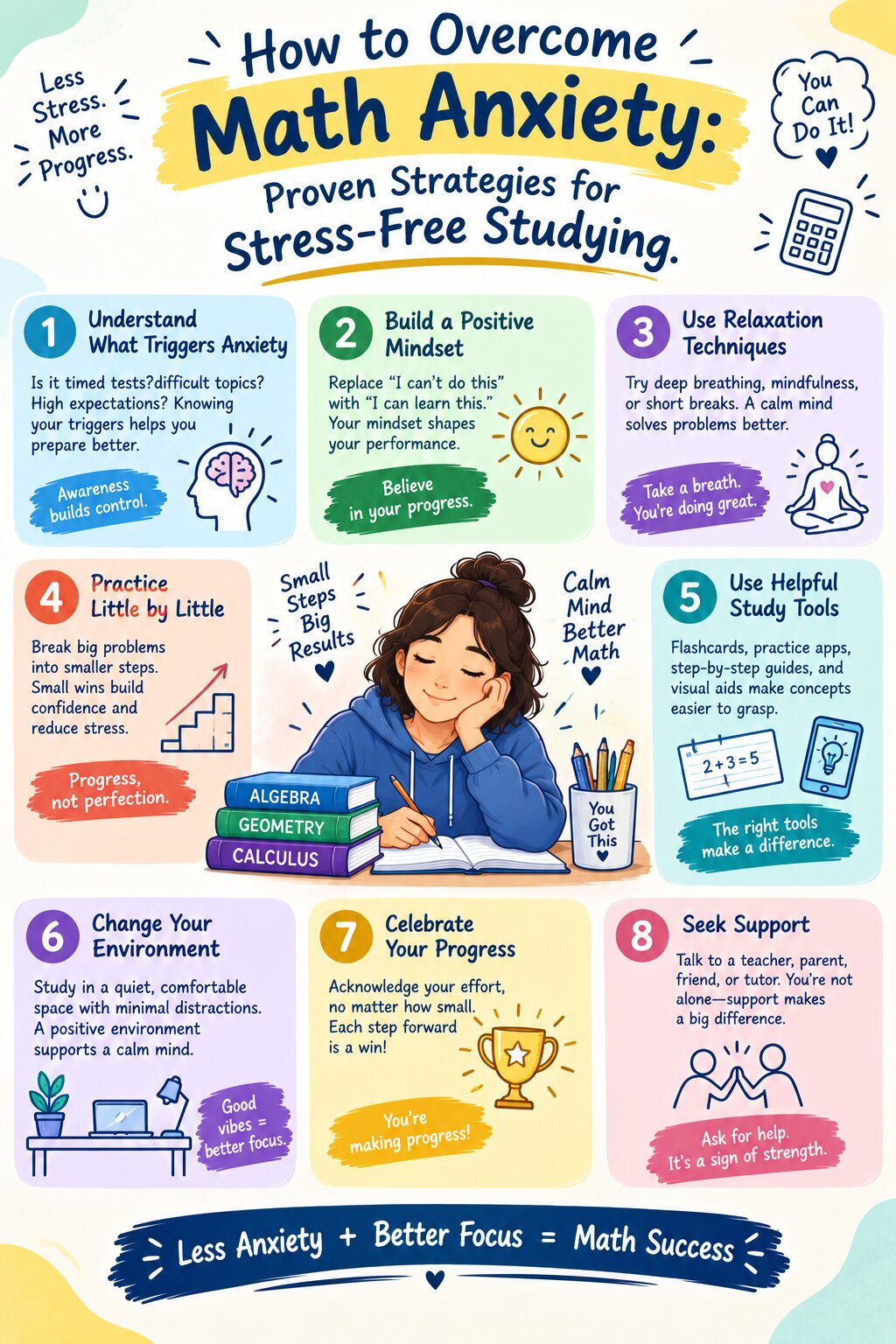
The Neurological Reality Behind the "Math Brain" Myth
Dismantling Toxic Academic Stereotypes
Many of us have heard this, or said it ourselves. But there is no scientific evidence for a fixed "math gene" that some people are born without. Mathematical skill, like playing cricket or learning a language, grows with practice, good explanations and time.
So why does your mind go blank? Researchers who study math anxiety describe how worry takes up space in your working memory, the mental workspace you use to hold numbers and steps while you solve a problem. When part of that workspace is busy with thoughts like "I'm going to fail", there is less room left for the formula you actually know. The knowledge is still in your head. Panic is just blocking the door.
Understanding this loop is powerful, because it means the problem is a stress response you can calm, not a limit you were born with.
3 Immediate Somatic Techniques for Test Panic
"Somatic" simply means working through the body. When panic hits, calm your body first and your thinking will follow. Each technique takes about a minute and can be done quietly at your desk.
1Box Breathing ~60 sec
- Breathe in through your nose for 4 seconds.
- Hold gently for 4 seconds.
- Breathe out slowly for 4 seconds.
- Hold empty for 4 seconds. Repeat 3 to 4 rounds.
25-4-3-2-1 Sensory Grounding ~60 sec
This pulls your attention out of racing thoughts and into the present room. Silently name:
- 5 things you can see (the clock, your pencil, the window…)
- 4 things you can feel (feet on the floor, the chair, the desk…)
- 3 things you can hear
- 2 things you can smell, and 1 thing you can taste
3Press, Release and Long Exhale ~45 sec
- Plant both feet flat and press into the floor for 5 seconds, then let go.
- Squeeze your fists under the desk, then release and drop your shoulders.
- Finish with a long breath out, longer than the breath in, repeated 3 times.
Then try one gentle step: read the whole paper first and start with the question you feel most sure about. An early win helps your mind settle.
Shifting from Performance-Focus to Cognitive Growth
Anxious students often treat every wrong answer as a verdict: "I'm bad at this." But learning works the other way. Your brain builds understanding by trying, getting feedback, and adjusting. A mistake is not proof that learning failed. It is the moment your brain finds out exactly what needs updating.
| Anxious thought | Growth reframe |
|---|---|
| "I got it wrong, so I'm bad at maths." | "I found a gap, now I know what to practise." |
| "I can't do this." | "I can't do this yet." |
| "Everyone else is faster than me." | "I'm working at my own pace, and speed comes later." |
| "I must get it right the first time." | "Each attempt teaches me something." |
Try a mistake journal. For each error, write three short lines: what I did, why it was wrong, and what I'll do next time. Over a few weeks, you will see patterns, and your errors will start to look manageable instead of scary.
Utilizing Private, Judgment-Free Tools to Rebuild Confidence
The Power of Safe Learning Environments
A lot of math anxiety is really social anxiety: the fear of being wrong in front of classmates or a teacher. Practising privately removes that pressure. With StudyHelpAI, you can try a problem on your own, check it, and make mistakes with nobody watching.
- Experiment freely. Change the numbers in our free calculators and watch what happens, with no one to judge your guesses.
- Ask again, in simpler words. If a step in the AI homework solver doesn't make sense, ask it to explain again, as many times as you need.
- Practise at low stakes. Build a quiz for yourself with the AI Quiz Generator, where a wrong answer costs nothing.
- Study in short, calm blocks. Use the Pomodoro Timer for focused 25-minute sessions with built-in breaks.
Conclusion: A Step Toward Fearless Learning
Math mastery is a journey, not a talent you either have or don't. You control the pace. Some days will feel easy and some will feel slow, and both count as progress. Be as kind to yourself as you would be to a friend who is struggling.
When you're ready, take one small step today: open the Maths Homework Help page, pick one problem you've been avoiding, and try it, with no pressure and no one watching.