The Student's Guide to Unit Analysis: How to Never Mix Up Units on an Exam
Imagine sitting down for an exam and completely forgetting the formula for a tricky problem. Your mind is blank. Yet you still write the right answer, because the units told you exactly what to do.
That is the power of unit analysis, also called dimensional analysis or the factor-label method. Most students treat units as annoying tags stuck on the end of a number. In reality, units are physical roadmaps. By cancelling them diagonally, you let the dimensions build the correct equation for you, and you get a built-in alarm that rings whenever your setup is wrong. This guide shows you how to use it step by step.
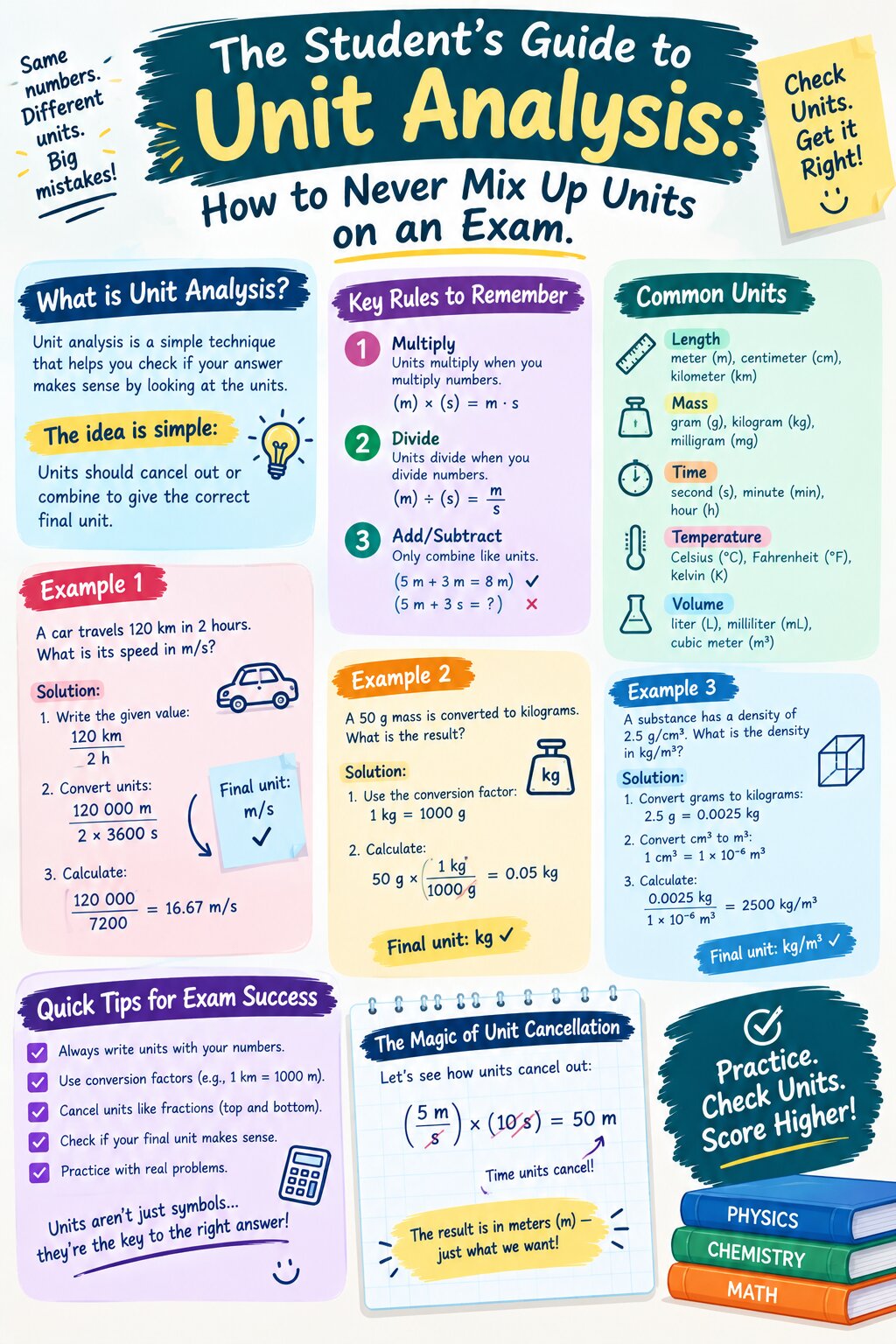
The Core Concept: The Mathematical Power of Multiplying by One
The Anatomy of Conversion Factors
Multiplying any number by 1 leaves its value unchanged. Now look at this fraction:
12 inches and 1 foot are the same length written two ways, so the top and bottom are equal and the fraction equals 1. Multiplying by it does not change the actual length. You are just shifting its skin, from feet into inches. A fraction like this is called a conversion factor.
Every conversion factor can be flipped, and both versions equal 1:
Which one do you choose? The one that puts the unit you want to get rid of in the denominator (the bottom), so it cancels, and the unit you want to arrive at in the numerator (the top).
The Diagonal Cross-Cancellation Blueprint
Step-by-Step Unit Cancellation Setup
For longer conversions, chain several factors together. Each new fraction's bottom unit cancels the top unit of the one before it, which creates a diagonal pattern of cancellations. Let's convert 3 days into seconds:
Write the starting value: 3 days.
Write the unit you want at the end: seconds.
Chain conversion factors so each bottom unit cancels the unit before it: days → hours → minutes → seconds.
Matching colours cancel diagonally: days, hours, min. Only s survives.
Multiply the top numbers and divide by the bottom numbers:
3 days = 259,200 seconds
Check that only the target unit remains. Everything else cancelled, so the setup is correct.
The Ultimate Exam Safety Net: Logic Auditing
Reading Your Final Answer Line
Before you circle your answer, read its units. If a question asks for velocity, your answer must end in a length divided by a time, such as m/s. If your leftover units are kg/s, you made a structural error, and you know it before the paper is even graded.
| Question asks for | Expected units | Your answer's units | Verdict |
|---|---|---|---|
| Speed | m/s | km·h | ✗ You multiplied instead of dividing |
| Speed | m/s | km/h | ✓ Valid dimension |
| Force | N (kg·m/s²) | kg·m/s² | ✓ Correct |
| Velocity | m/s | kg/s | ✗ Mass crept in |
Let the Units Build the Equation
Here is the exam-day miracle. Suppose a train travels at 50 km/h and you need the time for a 150 km trip, but you can't remember whether to multiply or divide. Let the units decide:
Only the version with km on the bottom cancels the kilometres and leaves hours. The units forced you to divide. If you had multiplied 150 × 50, you would have ended up with km²/h, which is clearly not a time.
One honest limit: unit analysis checks the structure of your answer, not the size of pure numbers. It cannot tell you about constants like the ½ in ½mv², so pair it with a quick sanity check on the size of your result.
Conclusion: Secure Your Exam Success
Mastering unit analysis by hand builds exceptional logical deduction skills, and it turns every unit on the page into a safety net. Practise the cross-cancellation setup until it feels automatic. Then visit our general converters hub to safely verify multi-step metric outputs before you submit homework.
You can also explore the Length, Time and Speed converters, or get worked solutions in Physics and Chemistry Homework Help.