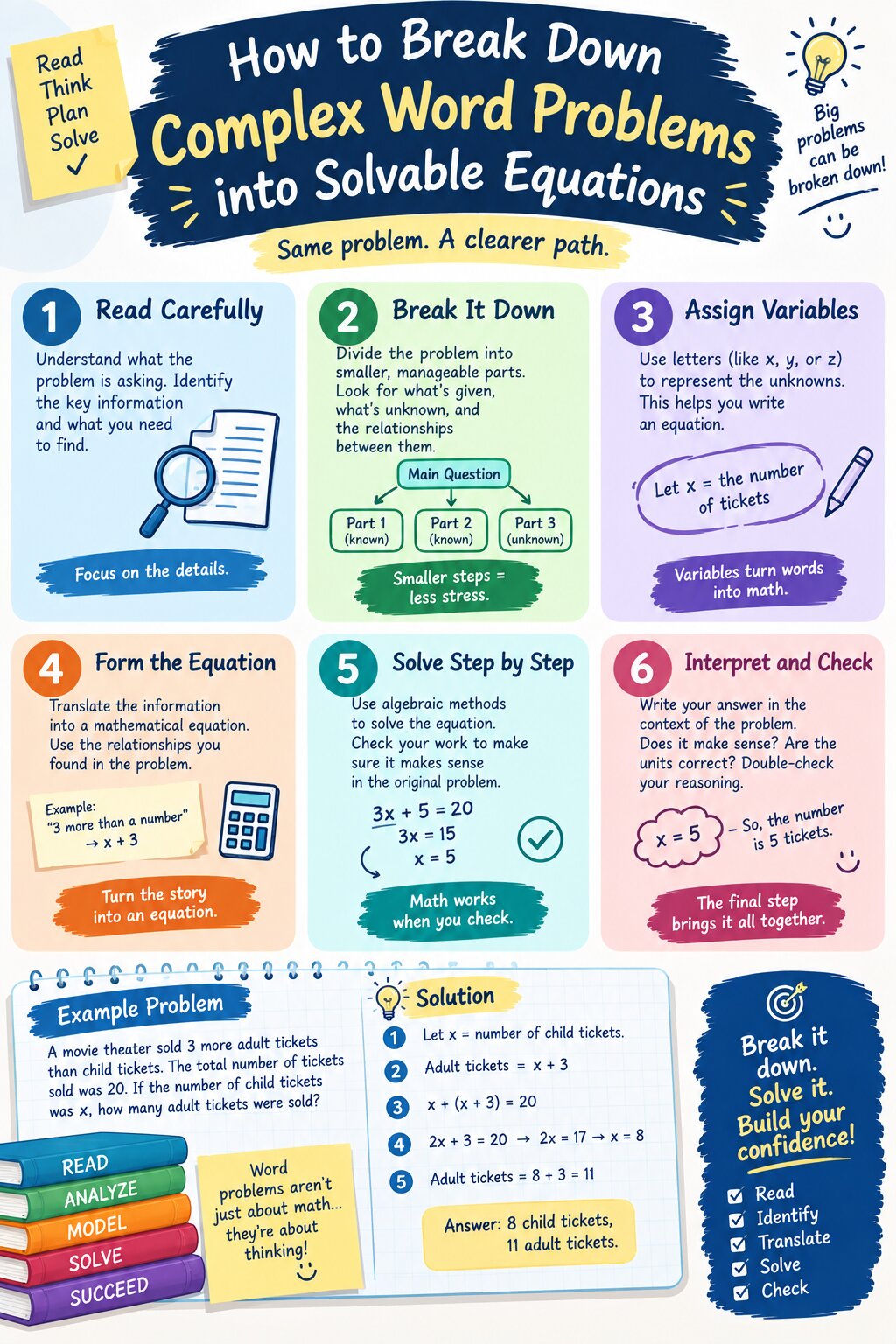
How to Break Down Complex Word Problems into Solvable Equations
You can solve 3x + 5 = 20 in your sleep. Then the same idea appears as a three-sentence story about a train, a rental shop or a shared pizza, and suddenly your mind goes blank. Why?
The maths did not get harder. It got disguised. A word problem is a standard equation written in code, and the code has a limited vocabulary. Learn the vocabulary, and translating a story into maths becomes a repeatable process instead of a guessing game.
The Math Translation Dictionary: Mapping Words to Operators
The Text-to-Operator Conversion Guide
Certain words appear again and again, and each one points to a specific operation. Keep this table next to your notebook:
| Keywords | Example → Expression | |
|---|---|---|
| + | sum, increased by, total, more than, plus, added to | "x increased by 5" → x + 5 |
| − | difference, fewer than, decreased by, less than, minus, left over | "8 fewer than x" → x − 8 |
| × | product, times, of, twice, double, each | "3 times a number" → 3x "40% of 50" → 0.4 × 50 |
| ÷ | per, quotient, split equally, shared among, ratio of | "₹120 shared among 4" → 120 ÷ 4 |
| = | is, equals, results in, gives, was, the total is | "The sum is 30" → … = 30 |
Filtering Out the Background Noise (The Red Herrings)
Textbook writers often add details that have nothing to do with the answer: the colour of a vehicle, a character's name, even an extra number. These red herrings test whether you can find what matters. Use this routine on every problem:
- Read twice. The first time, just follow the story. The second time, hold a pencil.
- Underline the question (what are you asked to find?) and name it with a letter.
- Circle numbers with units and cross out everything that does not change a calculation.
- Test each detail: "If I deleted this, would my equation change?" If not, it is noise.
Only 240 km and 4 hours matter. Speed = distance ÷ time = 240 ÷ 4 = 60 km/h. Notice that "12 coaches" is a number, but it is a distractor.
Step-by-Step Walkthrough: Mapping a Real-World Scenario
Find the question. We need the number of hours, so let h = hours rented.
Circle the numbers with units. ₹300 (flat), ₹150 (per hour), ₹1,200 (total).
Translate with the dictionary.
- "₹150 per hour" → ₹150 for each hour → 150h
- "flat fee plus" → + 300
- "total bill was" → = 1,200
Build and solve the equation:
150h = 1,200 − 300 = 900
h = 900 ÷ 150 = 6 hours
Check it against the story. 6 hours × ₹150 = ₹900, plus the ₹300 fee = ₹1,200 ✓. Answer: Meera rented the bike for 6 hours.
This is exactly a linear equation in the form y = mx + b: the ₹150 is the slope and the ₹300 is the starting value.
Conclusion: Conquer Your Homework Hesitancy
Deciphering the vocabulary builds real logical comprehension, because you are learning to read maths as a language. Once you have pulled out your own equation, run it through the StudyHelpAI AI homework solver to clear up any operational confusion and see every step explained.
For more practice, explore Maths Homework Help or our student calculators.