From Celsius to Fahrenheit: Real-World Scenarios Where Temperature Conversion Matters
You step off a plane in a new country, check the weather app and see "85°F". Or maybe it says "12°C". Is that a T-shirt or a winter coat? Without knowing the scale, you are guessing.
Here is the reassuring part: Celsius and Fahrenheit measure the exact same thing, the thermal energy of the particles in a substance. They are just different rulers. Understanding the maths that links them prevents mix-ups in travel, in the kitchen, and in the science lab.
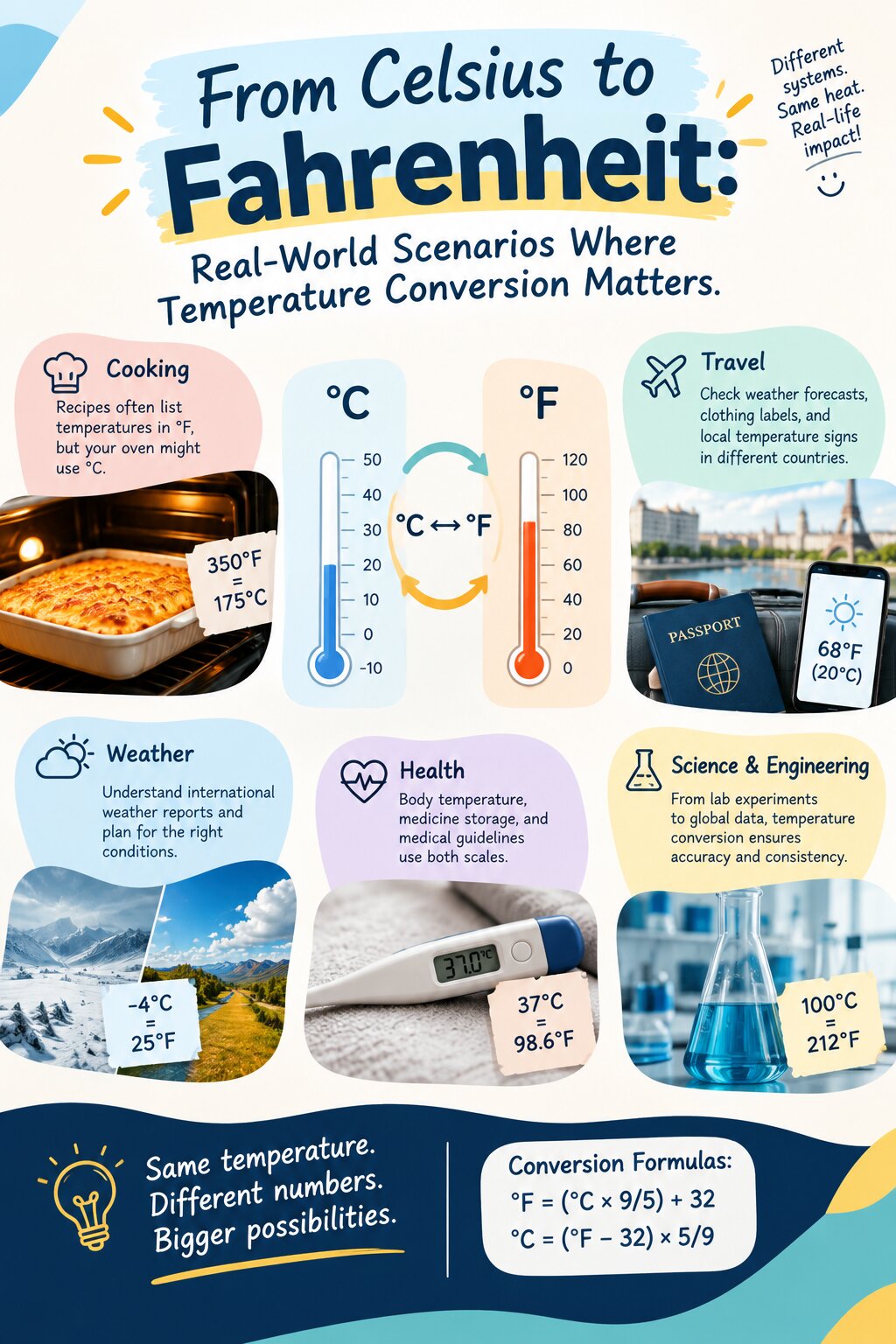
The Physics and Formulas Behind the Thermal Scales
Celsius → Fahrenheit
F = (C × 9/5) + 32
Fahrenheit → Celsius
C = (F − 32) × 5/9
The Fahrenheit Equation: F = (C × 9/5) + 32
F = 54 + 32 = 86°F
The Celsius Equation: C = (F − 32) × 5/9
C = 66.6 × 5/9 = 37°C
Why do the numbers 32 and 9/5 exist? Look at the two scales at the freezing and boiling points of water:
| Landmark | Celsius | Fahrenheit |
|---|---|---|
| Water freezes | 0°C | 32°F |
| Comfortable room | 20–25°C | 68–77°F |
| Human body | 37°C | 98.6°F |
| Water boils | 100°C | 212°F |
- The 9/5 (1.8): Between freezing and boiling, Celsius spans 100 degrees while Fahrenheit spans 180 (212 − 32). The ratio 180 ÷ 100 = 9/5, so each Celsius degree is 1.8 Fahrenheit degrees.
- The 32: Fahrenheit's zero is not water's freezing point. Water freezes at 32°F, so after scaling you shift the result up by 32.
For physics work you will also meet the Kelvin scale, where K = °C + 273.15. It uses the same size of degree as Celsius but starts at absolute zero.
The Ultimate Traveler's Cheat Code: Fast Mental Approximations
The Quick "Double and Add 30" Rule
When you just need a feel for the weather, use this shortcut: double the Celsius number, then add 30.
Going the other way, subtract 30 and halve: 80°F → 50 ÷ 2 = 25°C (exact: 26.7°C).
| °C | Quick estimate | Exact | Off by |
|---|---|---|---|
| 0 | 30°F | 32°F | 2°F |
| 10 | 50°F | 50°F | 0°F |
| 20 | 70°F | 68°F | 2°F |
| 30 | 90°F | 86°F | 4°F |
| 37 | 104°F | 98.6°F | 5.4°F |
When it is safe: everyday weather between about 0°C and 30°C, where being a few degrees off won't change what you wear. When it fails: the further you move from 10°C, the bigger the error grows. It also breaks down in sub-zero cold, and it is dangerously misleading for body temperature, where the estimate above shows a fever that isn't there.
When Approximation Fails: The Critical Need for Precision
Scientific Labs vs. The Culinary Arts
- Baking: A recipe calls for 180°C, which is 356°F, and US recipes round it to 350°F. The shortcut gives 180 × 2 + 30 = 390°F, about 34°F too hot. A delicate sponge could brown on the outside, collapse in the middle, or dry out.
- Sugar work: Syrup for caramel or fudge changes texture within a few degrees. Soft-ball stage is roughly 112–116°C (235–240°F), and missing it by a little gives a completely different result.
- Biology labs: Enzymes work best within a narrow range. Human enzymes prefer about 37°C, and heating them too far can permanently change their shape and stop them working.
- Chemistry: Reaction rates often rise sharply with temperature. A small error in the set value can speed up, slow down or even ruin an experiment.
- Health: A fever of 38°C is 100.4°F. Reading "38" on the wrong scale could mean a dangerously low temperature instead.
Always write the unit (°C or °F) next to every temperature in your working. A bare number could mean either scale.
Conclusion: Lock in Your Calculations
Learn both formulas well enough to use them in exams, where you will be asked to show the working. They are short, and you now know why every number in them exists. For homework review, let our Temperature Converter remove the human errors by confirming your final answers instantly.
Working on more units? Try the Unit Converter, or get step-by-step help in Physics Homework Help and Chemistry Homework Help.