Understanding Metric System Conversions: Tips, Tricks, and Essential Formulas
Here is a secret your science teacher would love you to know: the metric system is secretly the easiest measurement system in the world. Everything is built on powers of 10, so there are no awkward numbers like 12 inches in a foot or 5,280 feet in a mile.
So why do so many students still get stuck? The confusion usually comes down to one question: do I multiply or divide, and by 10, 100 or 1,000? This guide gives you a memory trick, a simple decimal-moving method, and a cheat sheet so you can convert with confidence.
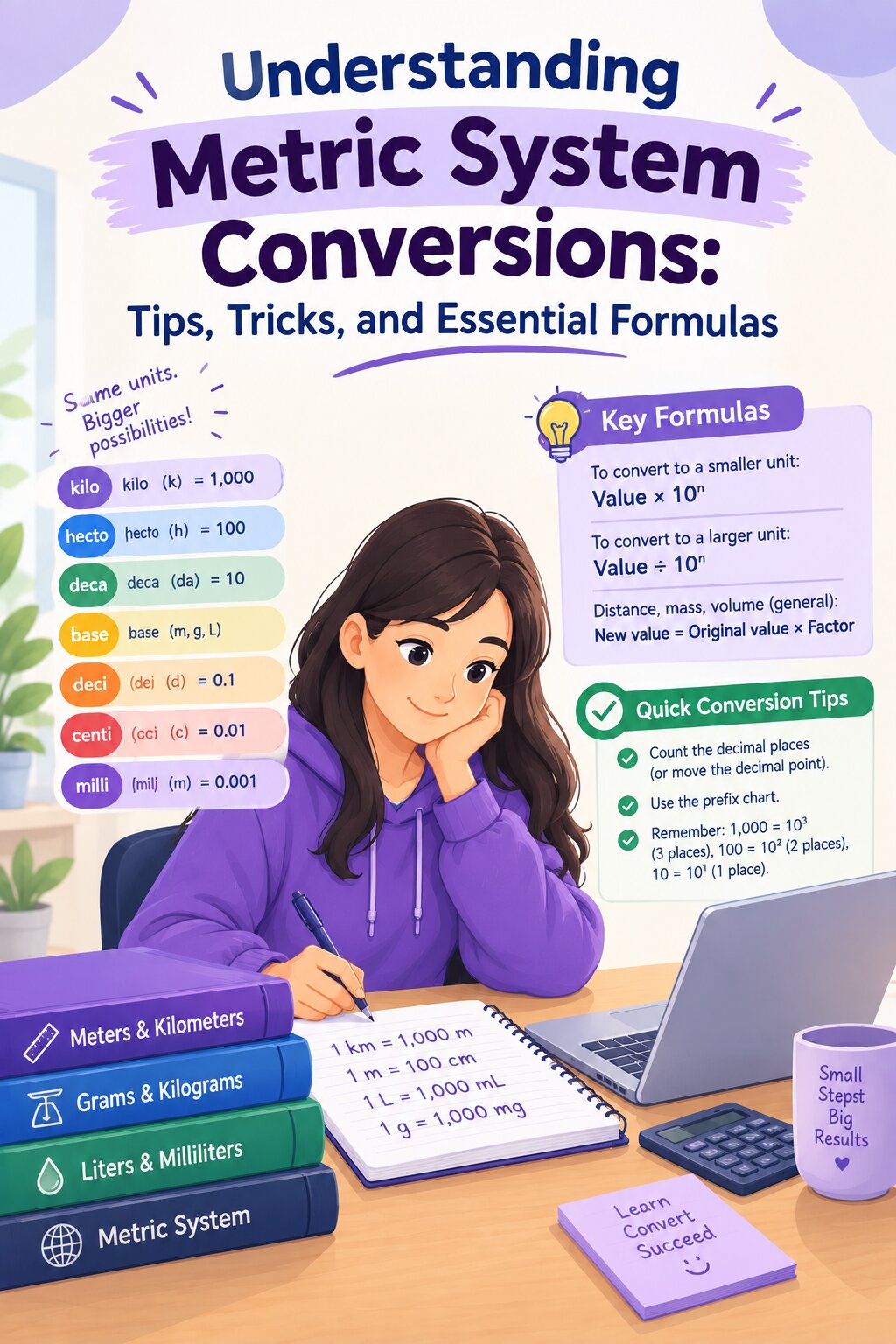
The Secret to Metric Prefixes: King Henry Died By Drinking Chocolate Milk
Breaking Down the Acronym
Every metric unit is a base unit plus a prefix that tells you how big or small it is. Memorize the order once with this silly sentence:
| Prefix | Meaning | Example |
|---|---|---|
| Kilo (k) | 1,000 × the base unit | 1 kilometre = 1,000 metres |
| Hecto (h) | 100 × the base unit | 1 hectolitre = 100 litres |
| Deca (da) | 10 × the base unit | 1 decametre = 10 metres |
| Deci (d) | 1/10 of the base unit | 10 decimetres = 1 metre |
| Centi (c) | 1/100 of the base unit | 100 centimetres = 1 metre |
| Milli (m) | 1/1,000 of the base unit | 1,000 millimetres = 1 metre |
The base unit is the metre (m) for length, the litre (L) for volume, and the gram (g) for mass. Each step on the ladder is a jump of exactly 10.
Moving the Decimal Point: The Quickest Conversion Trick
Each step along the ladder means moving the decimal point one place. Count how many steps separate your two units, then move the decimal that many places.
Converting from Large to Small (Multiplying / Moving Right)
Going from a bigger unit to a smaller one, you need more of the smaller units, so the number gets bigger. Move the decimal right.
5 km = 5 × 1,000 = 5,000 m
Converting from Small to Large (Dividing / Moving Left)
Going from a smaller unit to a bigger one, you need fewer of the larger units, so the number gets smaller. Move the decimal left.
250 cm = 250 ÷ 100 = 2.5 m
3,500 mg = 3,500 ÷ 1,000 = 3.5 g
Quick rule: big unit to small unit, the number grows. Small unit to big unit, the number shrinks.
Essential Metric Conversion Formulas You Need to Know
Keep this cheat sheet next to your notebook. These are the conversions that appear most often in maths, physics and chemistry.
📏 Length
- 1 km = 1,000 m
- 1 m = 100 cm
- 1 m = 1,000 mm
- 1 cm = 10 mm
⚖️ Mass
- 1 kg = 1,000 g
- 1 g = 1,000 mg
- 1 kg = 1,000,000 mg
- 1 tonne = 1,000 kg
🧪 Volume
- 1 L = 1,000 mL
- 1 kL = 1,000 L
- 1 mL = 1 cm³
- 1 L = 1,000 cm³
Common Pitfalls to Avoid on Science Exams
- Forgetting the base unit. Going from km to cm is not one jump. You pass through the base unit, so that is 5 steps (km → hm → dam → m → dm → cm).
- Counting decimal jumps incorrectly. Hecto and deca count as steps too. Write out the ladder and tick each jump.
- Moving the decimal the wrong way. Do a quick sense check: 5 km should be a huge number of metres, not 0.005.
- Mixing up m for metre and m for milli. "5 mm" is millimetres, while "5 m" is metres. One letter changes the answer by a factor of 1,000.
- Skipping a two-stage jump. Converting 4.2 kg to mg means kg → g (3 right) then g → mg (3 right), a total of 6 places: 4,200,000 mg.
Master Your Physics and Chemistry Homework Safely
The best way to lock in metric conversions is to practice by hand. Draw the ladder, count your jumps, and move the decimal yourself until it feels automatic. That skill will save you precious minutes in the exam hall.
When you want to double-check complex numbers, use our free Unit Converter to verify your answer instantly. For more help, visit Physics Homework Help and Chemistry Homework Help.