5 Smart Ways to Use AI Homework Helpers to Actually Learn, Not Just Copy
Within a couple of years, AI went from a curiosity to a tab that's open on nearly every student's laptop or phone. Type a question, get an answer in seconds. It feels like a superpower.
But there's a catch every student eventually discovers. Copy-pasting an AI answer finishes tonight's homework, and it does nothing for your brain. The exam paper won't have an AI sitting next to you, and the marks you skipped learning today will come due then.
The good news: AI is one of the best personalized tutors ever made, if you use it to reverse-engineer problems instead of outsourcing them. Here are five ways to do it properly.
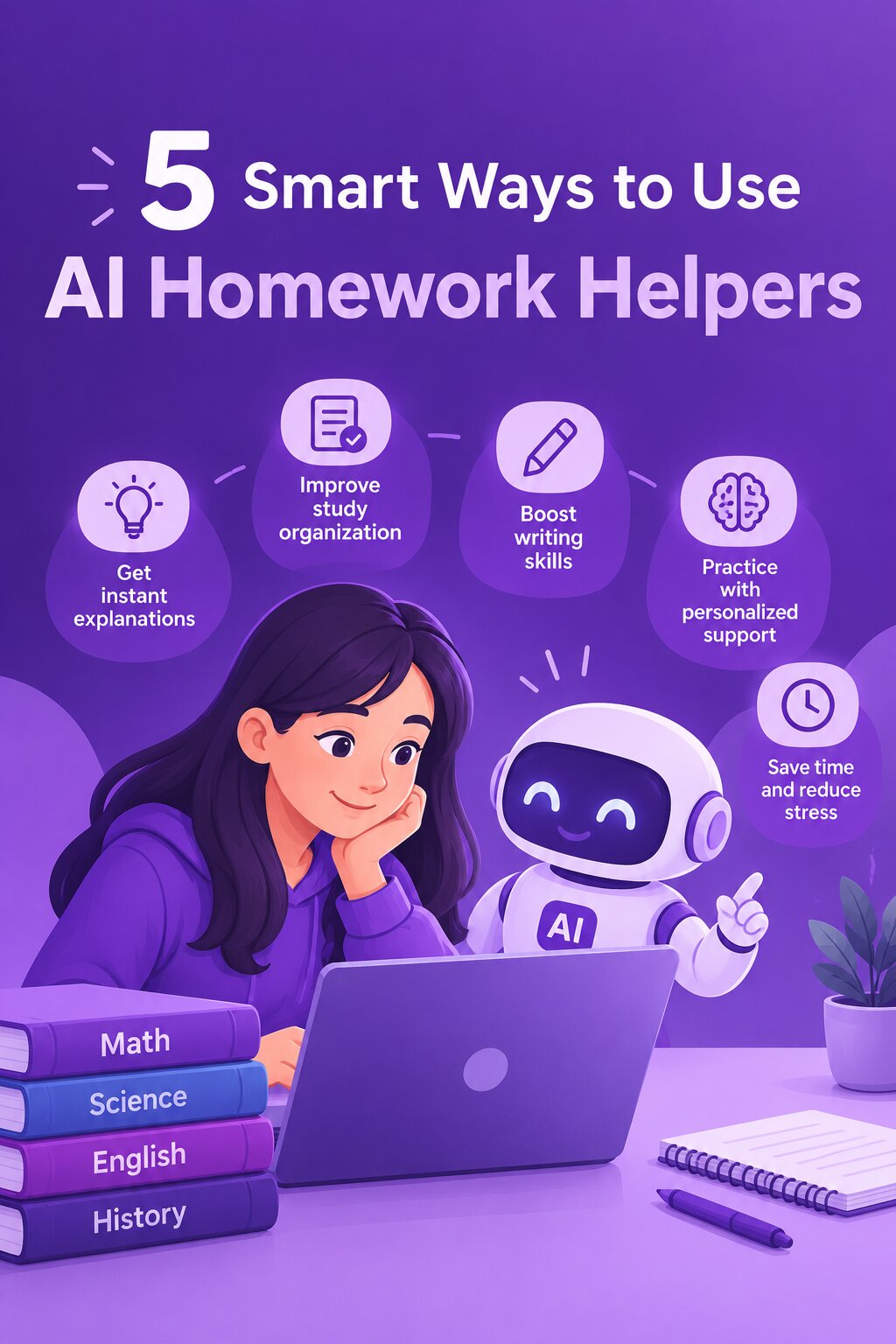
1Use AI to Reverse-Engineer Step-by-Step Solutions
Breaking Down the Formula
Asking "What is the answer?" gets you a number. Asking "Why did we do this step?" gets you understanding, and understanding is what earns marks.
Suppose you're solving a quadratic equation and the solution says, "Now factorise the expression." Don't just accept it. Ask:
- "Why did we choose these two numbers to split the middle term?"
- "What would happen if I did this step differently?"
- "Which formula or rule is being used here, and when can I use it again?"
For a physics numerical, ask why a particular formula was chosen over another, or why a unit was converted before substitution. Once you know the reasoning pattern, you can apply it to any similar problem.
2Generate Infinite Practice Problems for Exam Prep
Active Recall and Spaced Repetition
Reading a solved example feels productive, but it's passive. Research consistently shows that active recall (pulling information out of your memory) beats re-reading by a wide margin. Spaced repetition, revisiting material at growing intervals, then locks it in.
After you finish a textbook problem, paste it in and say:
Attempt them on paper and only then ask for the solutions. You can also:
- Ask for problems at increasing difficulty (easy, exam-level, tricky)
- Request mixed-topic questions the week before an exam
- Turn a chapter into revision cards, then review them over several days instead of one long night
3Use AI to Simplify Complex Academic Jargon
The "Explain It Like I'm 15" Method
Textbooks are often written for examiners, not students. A single paragraph on Le Chatelier's principle, opportunity cost, or Newton's third law can leave you rereading the same sentence four times. Paste the paragraph into an AI helper and ask:
- "Explain this like I'm 15, using an everyday example."
- "Now explain it using an analogy from cricket or cooking."
- "What are the 3 most important points I must remember for an exam?"
The important step comes next: close the chat and explain the idea back in your own words, out loud or on paper. If you can't, ask the AI for a different angle. The simple version is a bridge to the textbook language, not a replacement, because your exam will still use the formal terms.
If you study in a regional language, ask for the explanation in Tamil, Telugu, Hindi, Kannada or Malayalam. Understanding a concept in the language you think in often makes it click faster, and you can learn the English terminology alongside it.
4Treat AI as a Socratic Tutoring Partner
Asking Questions, Not Just Demanding Answers
The Socratic method is teaching through questions rather than statements. A good human tutor doesn't hand you the answer. They ask, "What do you already know here?" and let you get there yourself. You can make AI behave the same way:
- For essays: "Ask me 5 questions that will help me structure my argument. Don't write it for me."
- For revision: "Quiz me on this chapter, one question at a time, and tell me what I got wrong."
- For mistakes: "Here's my working. Don't fix it. Just tell me which line the error is in."
This takes more effort than copying, and that's the point. The mental effort is exactly what builds the skill.
5Fact-Check and Cross-Reference AI Outputs
Spotting AI Hallucinations
AI helpers are confident, and sometimes confidently wrong. This is called a hallucination: a plausible-sounding answer that is incorrect. It shows up as arithmetic slips, wrong constants, mixed-up dates, and invented facts. A verification habit protects your marks:
- Sanity-check the result. Does a calculated speed of 4,000 km/h for a bicycle make sense?
- Recalculate independently. If the calculator and the AI disagree, work out which is right before trusting either.
- Verify conversions. Unit conversions are a common source of quiet errors.
- Cross-reference facts with your textbook, teacher's notes, or an official source.
When you catch the AI making a mistake, you've learned the topic better than if it had been right the first time.
Summary: Shifting from Shortcuts to True Mastery
An AI homework helper is like a gym: it's only useful if you do the lifting. Copying answers is like paying someone to exercise for you, and the results never show up when it counts. Used well, AI can explain the why behind a step, generate endless practice, turn jargon into plain language, and challenge you with questions. Then verify what it tells you. The students who come out ahead are the ones who ask better questions, not the ones who get faster answers.